Personal Protective Equipment (PPE) is a temporary defense barrier against exposure to hazardous material. It is important to understand its limitations and how PPE works. In the hierarchy of controls, PPE is the last line of defense against hazards and is not a substitute for engineering controls, proper training, or safe work practices.
The Personal Protective Equipment Program was created to outline the requirements for selecting appropriate PPE and how to document the selection.
Hand Protection
When working in a laboratory, the hands are most likely to be exposed to hazardous material and should always be protected. Gloves are available in various materials, thicknesses, and with different cuff lengths for protection against different hazards. Always inspect gloves for holes and signs of degradation before beginning work with hazardous materials. Take care not to contaminate objects in the laboratory that are usually touched without gloves, e.g., phones, pens, computers, or faucets. Gloves should be removed before touching such objects. For the same reason, gloves should be removed when leaving the laboratory. They should not be worn in the corridors, elevators, or when touching door handles and buttons.
Glove Selection
Choosing the right glove for your application is essential. Watch the video below for guidance on glove selection.
Disposable Gloves
Disposable nitrile gloves provide very limited protection against chemicals and should only be used for handling powders and liquids of low toxicity in situations where incidental splashes may occur. They also provide good protection against biological material. Most chemicals will penetrate disposable gloves within seconds, so should your gloves become contaminated, remove them immediately and wash your hands. Disposable gloves have no mechanical resistance, should be changed frequently, and should never be reused. Latex gloves are not recommended for chemical use due to their potential for causing allergic reactions and lack of chemical resistance.
Reusable Gloves
Reusable gloves are thicker and more chemically resistant than disposable gloves. They often have a longer cuff to protect the wrist and lower arm. Butyl rubber, nitrile, neoprene, and Viton® are the most commonly used materials. Consult manufacturer glove selection charts when selecting a glove for a certain chemical. No material is acceptable for all chemicals.
They should be used when handling chemicals that are highly toxic by skin contact, or for handling large amounts of corrosive liquids. These types of gloves can also be used for procedures where immersion of the hands into liquid may be necessary, such as removing glassware out of an acid or base bath. However, it is recommended that alternatives to immersion (e.g. using tongs to remove glassware from a base bath) be pursued whenever possible. Before each use, reusable gloves should be inspected for pinholes, cracks, and excessive wear. Discard the gloves if they are damaged. After each use, rinse the gloves thoroughly and hang to dry. They can be used multiple times when properly maintained.
Silver Shield®/4H® gloves are recommend when working with highly toxic chemicals. They are made of a laminated polymer; a thin, light-weight material that provides excellent resistance against many chemicals, but not all. These gloves can be worn underneath a mechanically resistant glove when chemical and puncture resistance are required. Wearing a disposable glove over a Silver Shield glove improves the user’s dexterity.
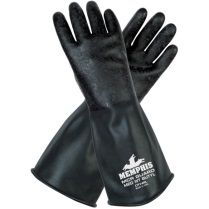 | 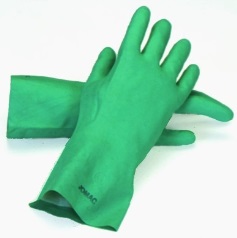 |  | 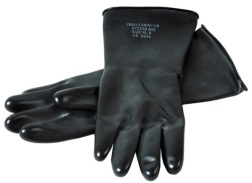 | 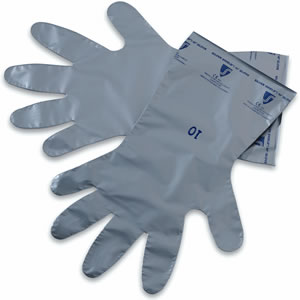 |
| Butyl Rubber Gloves | Reusable Nitrile Gloves | Neoprene Gloves | Viton Gloves | Silver Shield Gloves |
Flame Resistant and Heat Resistant Gloves
Flame resistant gloves, such as Nomex gloves, can be worn underneath disposable gloves to provide protection when working with pyrophorics. Heat-resistant gloves should be used for handling hot objects. They are often made of terry cloth and should not be used for handling cryogens.
 |  |
| Flame-Resistant Glove | Terry-Cloth Heat-Resistant Gloves |
Cryogenic Gloves
Cryogenic gloves protect from the extreme cold of cryogenic liquids. They must fit loosely so that they can be removed quickly should a splash occur. Cryogenic gloves are not heat resistant and the material may melt when touching hot objects.

Cryogenic glove
Cut-Resistant Gloves
Cut-resistant gloves are recommended for working with blades, broken glass, or stuck glass joints. Some cut-resistant gloves provide some protection against chemicals. Check the manufacturer’s specifications for chemical resistance information.

Wire Mesh Cut Resistant Glove
Leather Gloves
Leather gloves provide extra grip and abrasion protection for mechanical work, e.g. moving gas cylinders, or when handling hot glass. They do not provide protection against chemicals.
Eye and Face Protection
The eyes are particularly sensitive to most chemicals and allow infectious agents to enter the body. It is important to always protect the eyes from incidental splashes and impacts when working in a laboratory. Prescription glasses do not provide adequate protection against splashes or impact. Eye protection that fits over prescription glasses and prescription safety glasses are available. All eye protection should be ANSI Z87.1-2010 certified.
Safety Glasses
Safety glasses with side shields provide minimum protection against incidental splashes. Always wear safety glasses in the laboratory, even when not actively working.
Goggles
Goggles provide a higher level of protection than safety glasses. They should be used when handling highly corrosive chemicals that can permanently damage the eye.
The table below summarizes the different types of goggles available. All three types are impact resistant, but only unvented and indirectly vented goggles should be used with chemicals.
| Goggle Type | Picture | Protection Against Impact? | Protection Against Splashes? | Protection Against Vapors? |
| Unvented |  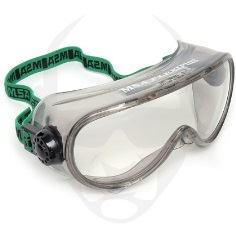  | Yes | Yes | Yes |
| Indirect vents | 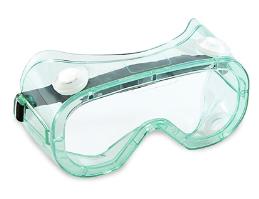 | Yes | Yes | No |
| Vented | 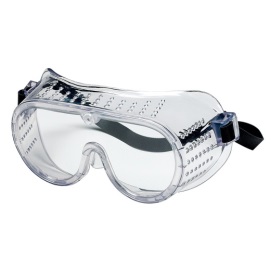 | Yes | No | No |
Face Shields
A face shield protects the face against splashes and impacts. It should be worn in conjunction with splash goggles when handling chemicals that are highly corrosive and/or toxic when in contact with skin, in particular when large volumes of liquid are used that make splashes likely. It should also be used when performing potentially explosive experiments.
Face shields come in different materials that vary in their resistance to chemicals and impact. They should be at least ANSI 87.1 certified.
For protection against aerosols and splashes of biological material, disposable face shields are also available. Disposable face shields are not impact or chemical resistant. Be sure to use an impact resistant face shield if your application requires it (e.g. handling samples stored in liquid nitrogen).
Body Protection
Clothing
Appropriate clothing provides basic protection against skin exposure. Footwear that completely covers the feet and clothing that covers the legs should always be worn in a laboratory. Loose clothing and long hair should be confined.
Laboratory Coats
Laboratory coats provide additional protection and keep hazardous materials off clothes, so they do not get transferred into areas outside the laboratory. Remove your lab coat before exiting the lab for this same reason.
Lab coats should be removed quickly if a splash occurs. Lab coats require a special laundry service and should not be taken home for washing. Check with your department about laundry services. As an alternative to laundering lab coats, disposable lab coats can be worn if the coat material is suitable for the hazards involved (see below).
Laboratory coats are available in different materials and different styles. Preferable styles include tight cuffs to prevent accidents and snap closures on the front so that the coat can be removed quickly should a splash occur. The choice of coat material depends on the hazard:
Polyester/cotton blends provide good protection against aqueous splashes but most chemicals will quickly penetrate the material. Because of the synthetic material content, polyester/cotton blends are not flame resistant and will quickly melt to the body if ignited.
100% cotton lab coats are not flame resistant but burn less readily than the polyester/cotton blends and the material will not melt. They are not splash resistant and they absorb fluids quickly.
Flame-resistant lab coats are blue. They are made either from flame resistant fibers or from cotton that was treated with a flame retardant. Resistance to chemicals is not always known and depends on the manufacturer. Flame-resistant lab coats cannot be washed with bleach. They require a special laundry treatment to maintain the flame resistance. Flame-resistant lab coats should be worn when handling pyrophoric material or large amounts of flammables.
Microbreathe and similar lab coats are disposable and are made from synthetic material. They provide good protection against aqueous splashes and body fluids. Resistance to chemicals is limited. They are commonly worn in biology and clinical labs. They are not flame resistant and should not be used when handling flammable material.
Aprons and Smocks
Chemically resistant aprons and smocks provide better protection against chemical splashes than lab coats. They can be made from a variety of materials including rubber, Neoprene, and Silver Shield. They should be worn for chemicals with a high dermal toxicity (e.g., hydrofluoric acid), when handling large amounts of corrosive chemicals, or when splashes are likely to occur. Check the manufacturer’s specifications to determine chemical resistance. Aprons should be worn in conjunction with a lab coat, but chemical resistant smocks can be worn on their own.
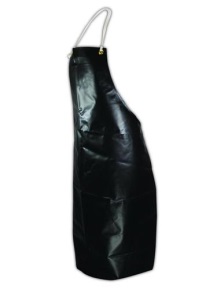 | 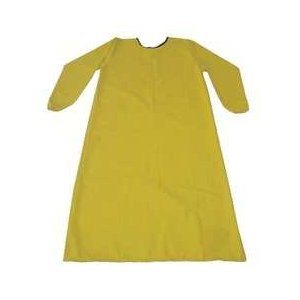 | 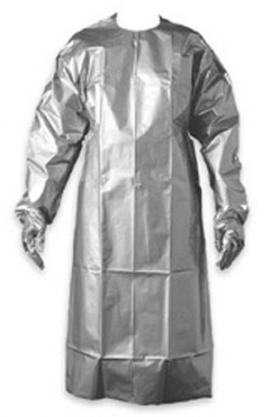 |
| Rubber-Coated Apron | Neoprene Smock | Silver Shield Smock |
Respirators
The University's Respiratory Protection Program is overseen by the Division of Safety and Compliance, Occupational Safety and Health Department. The program is intended to protect the health of faculty, staff and students when effective engineering or administrative controls are not feasible or practical, or in emergency situations; and to promote compliance with state occupational safety and health standards.
A respirator is used to prevent the wearer from inhaling dangerous airborne contaminants. Respirators fall into two categories based on how they protect the user. The first type of respirator removes contaminants from the air through filtration, absorption/adsorption or reaction/neutralization. The second type protects the user is by supplying clean respirable air from another source. Respirators that fall into this category include airline respirators, which use compressed air from a remote source, and self-contained breathing apparatus (SCBA), which include their own air supply. All potential respirator use must be approved by the Division of Safety and Compliance.
Using Risk Assessment to Select PPE
PPE is the last line of defense in the mitigation of risk. PPE should be selected only after elimination or substitution, engineering controls, and administrative controls have been put in place or rejected as a possibility. For example, a respirator should not be selected for protection against an inhalation hazard until it has been determined that using a chemical fume hood or other engineering control is not feasible or effective for the procedure.
Risk takes into account the severity of the hazard and the likelihood of a negative event occurring. Hazards are inherent to a material and do not change. Risk changes based on experimental variables like volume, concentration, and equipment. Level of risk will impact what PPE should be chosen for a procedure. For example, wearing a cotton lab coat while working with 10mL of a flammable solvent may be adequate, but working with 5 gallons of a flammable solvent may require a lab coat made with flame retardant material. A risk assessment should be performed before choosing what PPE to wear for a procedure.
Purchasing PPE
PPE can be purchased on campus at:
• ECE storeroom, 60 Everitt Lab, phone: 217-333-1916
• Life Sciences storeroom, C107 CLSL, phone: 217-333-7693
• MRL storeroom, 190 MRL, phone: 217-333-1375
• RAL storeroom, 94 RAL, phone: 217-333-3564
Or off campus at:
Grainger, iBuy, newpig, Northern Safety and Industrial, and many other stores.
References and Links
Ansell Chemical Resistance Guide
North Chemical Resistance Guide
Chemrest Chemical-Resistant Glove Directory
Online stores
Northern Safety Co., Inc. - A Wurth Group Company