For information on how to safely operate an autoclave see Autoclave Safety and Operation.
Related Links
Introduction
The Illinois Environmental Protection Agency (IEPA), Title 35 Illinois Administrative Code; Subtitle M Part 1420, requires that any potentially infectious waste that is generated must be treated to assure that it is safe for disposal.
On this campus, most biological waste is treated by autoclave. At least once per month, a test must be performed to confirm that the waste is properly treated. Those validation results are recorded through the DRS website.
Enrollment
Biological waste generated when working at Biosafety Level 2 (BL-2) or Animal Biosafety Level 2 (ABL-2) is considered potentially infectious. Labs working at those biosafety levels are automatically enrolled in the DRS Autoclave Waste Validation Program after receiving approval by the Institutional Biosafety Committee (IBC). DRS will contact the lab to schedule an initial orientation, covering how to order validation materials, accessing the online reporting log, and answer any questions pertaining to the program. Additional orientations or refreshers are available upon request.
Autoclaving Biological Waste
Campus minimum cycle parameters: 121°C (250°F), 15 psi, ≥ 60 minutes at temperature and pressure (excluding heat-up and exhaust phases). Cycle duration may need to be increased based on load size, density, and waste types and should be determined through validation.
Visual Indicators | Confirms temperature was reached but does not guarantee sterilization. |
Analog/Digital Indicators | Records time, temperature, and pressure. |
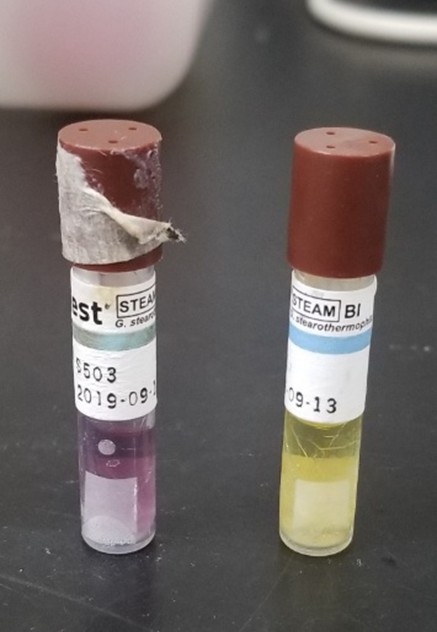
Biological Indicators
| Biological indicators contain Geobacillus Stearothermophilus spores and a growth medium with a pH indicator inside a sealed glass ampoule and used for the validation procedure. Pass: Purple, clear – no growth Fail: Yellow, cloudy– spores viable/bacterial growth A positive control (unautoclaved vial) can be used to confirm spore viability and proper indicator function. This vial should turn yellow and cloudy. |
Procedure
- Don PPE: lab coat, gloves, safety glasses.
- Verify spore vials are not expired.
- Secure the spore vial to a wooden dowel (do not cover cap vent holes).
- Place the vial in the center of the waste load.
- Autoclave waste using validated cycle parameters (121°C, 15 psi, ≥ 60 min).
- Following completion of cycle, seal bag and transport waste back to the lab.
- Allow waste to cool and retrieve the spore vial. Cool vial an additional 10 minutes (caution: vial is hot and pressurized).
- Do not discard waste until validation passes.
- Use crusher device to activate the autoclave test vial and positive control vial (if used). Be sure to label autoclaved and control vial.
- Incubate the vial(s) upright at 55°C for 18-24 hours.
- Interpret results
- If pass à waste may be over bagged and disposed of.
- If fail à re-autoclave waste and repeat validation.
Autoclave Inventory
To maintain an accurate inventory of autoclaves across campus, each autoclave is assigned a unique identification number by DRS.
If a new autoclave has been obtained, provide DRS with the following information:
- Building and Room #
- Manufacturer
- Serial #
- Model Name
- Optional: External identification (created by facility/department)
Notify DRS when an autoclave has been purchased or installed, relocated, or permanently removed.
Associating an Autoclave with your Lab:
- Log into the DRS website
- Click on Profile
- Under “Facility Info” – Select “Autoclave Waste Validations”
- Click on the blue “Manage Autoclaves” button
- Select the Responsible Person (the PI)
- Select the appropriate autoclave
- Click the orange “Add” button
- Repeat steps 5-7 if adding more than one autoclave
- Be sure to update IBC projects to include appropriate autoclaves
FAQs
- If I’m not generating BL-2 waste, do I still need to validate?
- A test is not required if you do not have BL-2 waste to autoclave during any given month, but you must still submit an entry and select “Not enough BL-2 waste generated to perform validation” or “Only generated BL-1 waste - no validation required.”
- Other labs in my building use this autoclave and do this test. Do I still have to do it?
- Yes. Each lab is responsible for verifying that their own waste is properly treated. Even when using a shared autoclave, waste composition, load configuration, and volume can vary between labs and may affect sterilization efficacy. Validation confirms that the cycle is effective for your specific waste.
- What if my validation fails?
- Re-autoclave the load and repeat the test. Confirm the cycle parameters (correct time, pressure, and temperature) were achieved. Adjust onefactor at a time (e.g., increase time, reduce load density, improve loading (no stacking), add water (250mL to dry loads). If repeated failures occur, contact DRS@illinois.edu and notify the building manager.
- Who can enter validation results into the system?
- Any individual listed as personnel under the PI/Responsible Person is authorized to submit validation results.
- I forgot to submit an entry on the DRS website. What do I do?
- The system allows you to submit results from previous months if forgotten. If multiple months are missed, DRS will reach out to assist if needed.
- How do I store the spore vials?
- Spore vials should be stored at room temperature in a dry location.
- Can I reuse the dowel and the crusher tool?
- Yes, these items may be reused but must be decontaminated following a failed test.
- What do I do with the spore vials after the validation process is complete?
- The autoclaved spore vial, if it remains purple (pass), can be discarded in the autoclaved biohazard bag, over-bagged, and disposed of. If the spore vial is yellow (fail), it can be discarded in the biohazard bag, and a new spore vial will be used to retest the same bag of waste. If using a control vial and it turns yellow, this can be discarded in either a biohazard container that will still need autoclaved or a sharps disposal container.
References